FinnOne Neo®






 Lending
 Transaction Banking
 Financial Inclusion
 Technology


























Every time a banking application changes, someone has to test it. A new field, a modified workflow, a system upgrade or a small UI change can mean hundreds of checks before the release can go live.
For business and operations teams, this creates a familiar problem. People spend hours repeating the same test scenarios instead of focusing on their day-to-day responsibilities. Traditional automation helps, but it comes with its own challenge: applications change, automation scripts break, and someone has to maintain them.
Nucleus’s AI-powered regression testing platform is designed to address this gap.
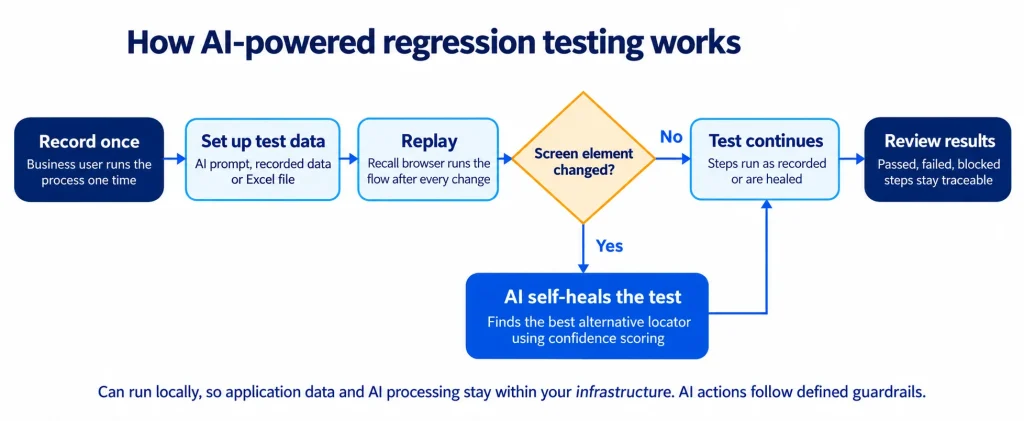
The platform allows business and testing teams to record a process once and replay it whenever required. There is no need to write complex automation scripts. Test scenarios can be created through recorded workflows, while AI can assist with test case and test data generation.
Self-healing Testing Is the New Age Testing

Self-healing is the ability of test automation to adapt to certain application changes instead of failing. Automated tests find each screen element, such as a button or a field, through a locator. When that element moves, is renamed or is modified, the original locator stops working, and a traditional script fails until someone repairs it. With self-healing, the platform detects the change, evaluates alternative ways of identifying the element, and selects the most reliable match using confidence scoring. The test then continues where possible. Self-healing significantly reduces routine maintenance, but it does not remove the need for human oversight. Every healing action is recorded in the reports, so teams can review it and decide whether further changes are needed.
The Bigger Advantage Comes When the Application Changes

If an element on a screen moves, is renamed or is modified, the platform can identify the change and look for the most reliable alternative locator. This self-healing capability allows tests to continue running with significantly less manual intervention. Instead of spending time fixing automation scripts after every application change, teams can spend more time analysing actual test results.
The platform also supports multiple approaches to test data. Teams can generate realistic data using natural language prompts, capture data while recording a test, or run the same scenario against multiple datasets through Excel.
Security is built into the approach. The platform can run locally, keeping application data and AI processing within the institution’s infrastructure. AI actions are controlled through defined guardrails, while test execution, healing activity and results remain traceable through detailed reports.
The business impact is straightforward:
- faster regression testing
- earlier identification of defects
- better test coverage
- less repetitive work for business and operations teams.
The platform lets business teams record a process once, replay it on demand and keep tests running when screens change. For banks and financial institutions, where every release touches customer journeys, regulatory reporting and money movement, the benefits show up in six areas:
- Speed: Large numbers of UAT checks across banking, lending, trade finance run much faster. Testing and sign-off cycles get shorter, so releases are not held back by manual testing.
- Productivity: Finance and operations teams are freed from repetitive checks and can focus on their core responsibilities. Experienced people can return to reconciliations, exception handling and customer facing work
- Coverage: More scenarios and business journeys can be tested in every release, including the same scenario across multiple datasets such as different products, customer types or transaction values.
- Quality: Defects are found earlier in the process, before a change reaches users. Detailed reports keep test execution, healing activity and results traceable for internal review.
- Agility: Product launches, regulatory changes and system upgrades reach the business faster. Automation then becomes a business agility benefit, not only a testing benefit.
- Cost efficiency: Less effort goes into repetitive UAT, and self-healing reduces the maintenance effort that usually comes with automation. Because the platform can run locally, application data and AI processing stay within the institution’s infrastructure.
The objective is not to replace business expertise. It is to remove the repetitive testing burden so that experts can spend their time where it matters most – validating business outcomes, resolving exceptions and getting changes safely into production faster.
Frequently Asked Questions
Why is regression testing important?
Applications are continuously changing. A change that appears small can affect an existing feature or business process. Regression testing helps identify such issues before the updated application reaches users.
How is AI-powered testing different from manual testing?
In manual testing, business or testing teams repeatedly perform the same checks. With AI-powered automation, these checks can be recorded and executed automatically, reducing repetitive effort and speeding up testing.
Does the platform require coding skills?
No. The platform is designed to support business and testing users through a no-code approach. Users can record workflows and replay them without having to write traditional automation scripts.
How does the platform create an automated test?
A user performs the required business process while recording. The platform captures the actions and converts them into repeatable test steps that can be executed again whenever required.
Can business users create tests themselves?
Yes. The platform is designed to make test creation accessible to business and operations teams who understand the application and business process but may not have programming or automation expertise.
What happens when the application UI changes?
The platform can identify when a previously recorded UI element has changed, moved or is no longer available at its original location. Its self-healing capability can identify an alternative locator and continue the test where possible.
What is self-healing test automation?
Self-healing means the automation can adapt to certain application changes instead of simply failing. The platform evaluates alternative ways of identifying an element and selects the most reliable match based on confidence scoring.
Does self-healing eliminate test maintenance completely?
No. Self-healing is designed to significantly reduce routine maintenance, not eliminate the need for human oversight. Teams can review healing activity and determine whether further changes are required.
How does the platform generate test data?
Test data can be created in three ways: AI-generated data using natural language prompts, data captured during test recording, or data supplied through Excel for data-driven execution.
Can AI generate multiple test scenarios?
Yes. AI can help generate realistic variations of a test scenario.