FinnOne Neo®






 Lending
 Transaction Banking
 Financial Inclusion
 Technology


























Sri Lanka’s banking sector has moved past the point of simply asking whether services are online. The real question now is how effectively banks convert that digital access into customers who transact more, cost less to serve, and generate steadier fee income.
The numbers back this up. Sri Lanka’s Fast Payment System recorded a 34.1% jump in transaction value in 2025, touching Rs. 23.13 trillion[1], and the Central Bank continues to flag digital payment adoption as central to how the country’s financial system is modernising.
Fee income is following the same curve. Net fee and commission income across Sri Lanka’s banking sector rose from Rs. 144 billion in 2024 to Rs. 169.1 billion in 2025[2], which tells you where banking economics are headed: less reliance on interest spreads, more on non-interest income.
For corporate banking specifically, that shift raises the stakes on transaction banking. Corporate customers want faster payments, real visibility into their cash position, and fewer manual steps. Banks need infrastructure that can absorb rising volumes without a matching rise in operational load.
For corporate banking specifically, that shift raises the stakes on transaction banking. Corporate customers want faster payments, real visibility into their cash position, and fewer manual steps. Banks need infrastructure that can absorb rising volumes without a matching rise in operational load.
So, what does that actually look like once it’s working? One of Sri Lanka’s largest private banks gives us a five-year answer.
Five Years On, The Numbers Are Still Climbing

Most technology partnerships have a moment everyone remembers: go-live, a press release, a handshake. What matters far more is what happens after that moment fades.
For the bank, what’s happened since is sustained growth.
The bank implemented FinnAxia®, Nucleus Software’s transaction banking platform, to rebuild how it serves its corporate customers across cash management, trade finance and digital self-service, not just a technology refresh, but a change in how corporate customers bank with the bank day to day, backed by infrastructure that could scale with a growing portfolio.
Five years later, the adoption curve hasn’t flattened.
What The Numbers Say?
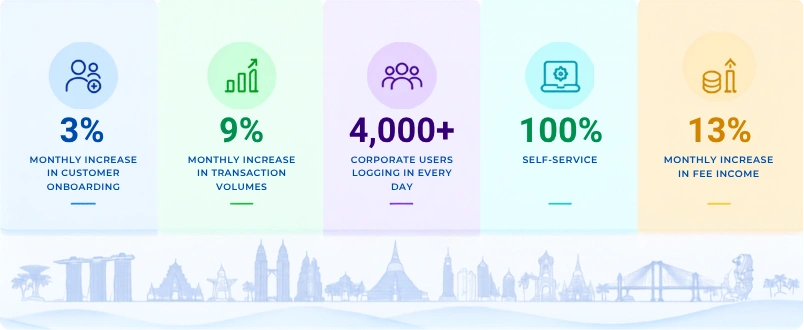
- 3% average monthly increase in customer onboarding, sustained over 18 months: The platform keeps opening a digital front door for new corporate customers to start banking with the bank.
- 9% average monthly increase in transaction volumes, sustained over 18 months: This matters more than onboarding on its own, because it shows customers coming back to actually use the platform for everyday activity, not just registering and drifting off.
- 4,000+ corporate users logging in every day: Digital banking has become part of the daily routine for the bank’s corporate base, not a fallback channel.
- 100% self-service: Routine corporate banking now runs through a secure digital environment, cutting reliance on branch and assisted processes and tightening turnaround time.
- 13% average month-on-month increase in fee income, sustained over 18 months: The commercial payoff. Higher usage translates into deeper engagement and a real, growing stream of fee-based revenue.
Why This Matters More Now?

Sri Lanka’s payment ecosystem isn’t standing still. The Central Bank continues pushing digital payments, system modernisation and technology risk management, and in 2025 alone the Fast Payment System processed Rs. 23.13 trillion in transaction value, up 34.1% year on year.
For banks, the question isn’t whether customers have digital access anymore. It’s how effectively that access converts into deeper relationships and sustainable transaction volumes and that question sits squarely in corporate banking.
A corporate customer isn’t thinking about “digital transformation.” They’re thinking about whether they can make a payment without a branch visit, check their cash position quickly, move money securely, and manage trade activity without someone else’s intervention. The bank is solving a parallel problem: serve more customers, process more volume, cut operational friction, and grow revenue without the cost of servicing every relationship rising in lockstep.
That’s the gap transaction banking infrastructure is built to close.
From Digital Access to Digital Behaviour

What makes the bank’s experience worth studying isn’t the technology rollout, it’s what shows up in customer behaviour afterward.
A platform can go live in months. Changing how thousands of corporate customers actually bank takes years.
Five years of continued, growing usage is a different kind of proof point than a launch date. It’s not “were customers onboarded to a digital platform”, it’s “did digital banking become the default way they handle everyday transactions.”
More than 4,000 daily corporate users, transaction volumes still climbing, and 100% self-service adoption together suggest the digital channel isn’t an add-on for the bank’s corporate customers anymore – it’s how they bank. And the continued rise in fee income is what turns that adoption into a number the business side actually cares about.
What Other Sri Lankan Banks Can Take from This?

The next phase of transaction banking transformation in Sri Lanka won’t be defined by who goes digital first. It’ll be defined by what banks do after that.
Can the platform keep pace with a growing corporate base? Can transaction volumes keep climbing? Can routine activity keep shifting away from branches? Does digital adoption actually show up in fee income? And the harder question, can the platform keep delivering on all of this years after go-live, not just in the first year?
This bank’s five-year run offers one answer.
The real measure of a transaction banking transformation was never the day the platform went live. It’s what the numbers look like five years later.