FinnOne Neo®






 Lending
 Transaction Banking
 Financial Inclusion
 Technology
























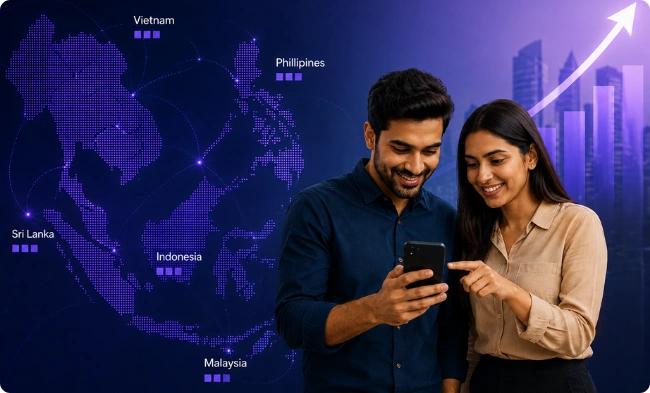

Southeast Asia’s digital lending landscape is growing rapidly, but not every market is evolving at the same pace. While every market is moving towards greater digitalisation, each is shaped by its own regulatory priorities, level of financial inclusion, digital infrastructure, and customer expectations. For banks looking to expand or modernise their lending operations, understanding these differences is far more valuable than viewing Southeast Asia as a single market. This article explores how Vietnam, the Philippines, Sri Lanka, Indonesia, and Malaysia compare in their digital lending maturity and what that means for financial institutions.
Southeast Asia’s banking markets are digitizing on very different timelines. Vietnam is racing ahead on infrastructure and volume. The Philippines is still closing a fundamental access gap. Sri Lanka is rebuilding from crisis with a surprisingly strong digital foundation already in place. Indonesia is scaling fast across a vast archipelago while working through a consolidation phase. Malaysia is taking the most deliberate, inclusion-first approach to digital banking in the region. For banks weighing where and how to invest in digital lending capability, understanding these differences matters more than treating “Southeast Asia” as one market.
Digital Lending in Vietnam: Scale and Speed, With Regulation Catching Up

Vietnam’s digital banking infrastructure has moved further, faster, than almost anywhere else in the region. By 2025-26, close to 95 percent of all banking transactions in the country are processed through digital channels, and several credit institutions already conduct more than 95 percent of their activity digitally, according to industry tracking of State Bank of Vietnam data[1]. Mobile banking adoption has grown 27 to 30 percent year-on-year, while non-cash payment volumes have surged more than 60 percent compared to the previous year.
On the lending side specifically, the State Bank of Vietnam has reported personal loan growth of around 15 percent year-on-year[2], and average loan processing time has fallen to under 24 hours for many digital products. The fintech lending and digital microfinance segment alone is now valued at roughly USD 5 billion, with strong momentum from urban centers like Ho Chi Minh City and Hanoi.
What makes Vietnam distinct is that this growth is now running into a more deliberate regulatory phase rather than a pure speed-to-market environment. Decree 94, which took effect in mid-2025[3], created a formal regulatory sandbox under State Bank of Vietnam oversight for fintech lending models including P2P, alongside Vietnam’s new AI Law (effective March 2026)[4], which introduces risk-based compliance obligations for underwriting and credit-decisioning systems. For banks operating in Vietnam, the opportunity is less about basic digital enablement, which is largely solved, and more about building lending infrastructure that can absorb tighter governance requirements around AI-driven credit decisions without slowing down approval speed.
Where the market sits: Vietnam is in a scale-and-govern phase. The infrastructure question is answered; the open question is whether core lending platforms can keep pace with new AI and data-governance obligations while preserving the speed customers already expect. This is precisely where lending platforms with built-in governance and audit trails, rather than governance bolted on after the fact, earn their place on a bank’s shortlist.
Digital Lending in the Philippines: Inclusion Is the Story, Not Just Digitization

The Philippine market looks different. Account ownership and digital engagement are climbing quickly, but lending penetration itself remains comparatively shallow, and the central bank’s own data tells a more complicated story than “fast growth.”
The Bangko Sentral ng Pilipinas’s 2025 Consumer Finance and Inclusion Survey[5] found that the share of adults who borrowed actually fell, from 45 percent in 2021 to 25 percent in 2025. The encouraging part of that finding is qualitative rather than quantitative: borrowing is shifting away from informal moneylenders toward safer, regulated formal credit. Account ownership among young adults aged 15 to 19 rose to 34 percent in 2025 from 27 percent in 2021, and for the first time, women’s bank account ownership (25 percent) now exceeds men’s (22 percent).
Digital lending products, particularly Buy Now, Pay Later, are doing real work as an entry point into formal credit. A widely cited TransUnion consumer study[6] found that the large majority of Filipino respondents were aware of BNPL services, with a majority having used one in the past year, usage skewing heavily toward Gen Z. For thin-file borrowers with no prior credit history, that repayment data is increasingly feeding into formal credit bureau records, effectively turning BNPL into a credit-building product.
The Bangko Sentral ng Pilipinas’s regulatory architecture, particularly Circular 1133, governs digital lending platform licensing and consumer protection, and the central bank’s National Strategy for Financial Inclusion 2022–2028[7] explicitly targets a more cash-light, digitally inclusive economy by 2028.
Where the market sits: The Philippines is in an inclusion-building phase. The opportunity for lenders is less about raw transaction volume and more about credit products and onboarding journeys that can responsibly bring first-time, thin-file borrowers into the formal system, with alternative data and disciplined risk scoring doing the heavy lifting. A loan origination layer flexible enough to score thin-file borrowers on alternative data, without rebuilding the underwriting engine from scratch, is what turns that opportunity into disbursed loans.
Digital Lending in Sri Lanka: A Faster-Than-Expected Digital Recovery

Sri Lanka’s banking sector is rebuilding from the 2022 economic crisis, and the recovery numbers from the Central Bank of Sri Lanka are notably strong[8]. Credit extended by licensed banks and finance companies accelerated through Q1 2026, with the sector’s credit-to-deposit ratio surpassing 70 percent for the first time in three years. Asset quality has improved sharply: Stage 3 (non-performing) loan ratios in the finance company sector fell from 8.6 percent at end-Q1 2025 to 4.4 percent at end-Q1 2026.
Digital channel adoption has kept pace with that recovery. Industry tracking points to digital banking penetration reaching roughly 65 percent of customers[9], with mobile apps now processing around 70 percent of transactions, cutting institutions’ operational costs by close to 30 percent. The Central Bank of Sri Lanka’s Payment System Roadmap 2025-2027[10] is pushing further toward a less-cash, digitalized economy, with additional cross-border payment linkages planned for 2026.
Industry commentary, including from senior bankers quoted in LMD’s 2026 banking sector coverage[11], points to Sri Lanka already having relatively high banking penetration by regional standards, with roughly 20 million debit cards in circulation against the adult population. The next frontier isn’t access, it’s intelligence: banks are actively exploring AI-assisted credit decisioning, including integration with the Credit Information Bureau for faster assessments, and alternative data sources, like utility payment history, to extend micro-lending to segments still outside the formal system.
Where the market sits: Sri Lanka is in a consolidation-and-intelligence phase. Access and digital rails are largely in place; the opportunity is upgrading decisioning speed and sophistication, particularly for SME and retail lending, while maintaining the asset quality discipline regulators are watching closely post-crisis. Banks here are increasingly looking for transaction banking and lending platforms proven in similarly disciplined, post-recovery environments, where corporate self-service and faster credit decisions need to scale without reopening old asset quality risks.
Digital Lending in Indonesia: Scale Across an Archipelago, With a Necessary Shake-Out Underway

Indonesia is Southeast Asia’s largest digital lending market by sheer scale, and it’s still growing fast even as it goes through a period of overdue consolidation. Outstanding fintech lending reached IDR 98.54 trillion (roughly USD 5.8 billion) as of January 2026, up 25.5 percent year-on-year, according to Financial Services Authority (OJK)[12] data. Notably, more than a quarter of loan disbursements now go to borrowers outside Java[13], a sign that digital lending is genuinely reaching beyond Indonesia’s traditional urban financial centers.
That growth sits against a backdrop of real credit scarcity. The International Labour Organization estimates that private sector credit in Indonesia equals only about 25 percent of GDP, compared with 108 percent in Malaysia, 84 percent in Thailand, and 114 percent in China, underscoring how much headroom remains even after years of fintech lending growth.
The market is also actively consolidating. OJK has shut down or blocked more than 12,800 illegal lending entities since 2017-18, including 951 in the first two months of 2026 alone, and the regulator’s December 2025 minimum equity requirement (IDR 12.5 billion) pushed several licensed platforms, some backed by major corporate groups, to exit or restructure. Credit risk has risen alongside the growth: the industry’s 90-days-past-due ratio climbed from 2.52 percent to 4.33 percent year-on-year as of November 2025, a clear signal that underwriting discipline is now the differentiator between platforms that survive consolidation and those that don’t.
Where the market sits: Indonesia is in a scale-with-discipline phase. Distribution reach and borrower demand are not the constraint; underwriting quality, risk management infrastructure, and the ability to operate profitably under tightening capital and compliance requirements are what will separate durable lenders from the next wave of market exits. Configurable credit policies and rules-based underwriting that can flex by region and segment, rather than a one-size-fits-all scorecard, matter more here than almost anywhere else in the region.
Digital Lending in Malaysia: The Most Deliberate, Inclusion-Governed Build in the Region

Malaysia’s approach to digital lending stands apart for how closely growth is being managed against financial inclusion outcomes. Bank Negara Malaysia (BNM) licensed five digital banks under its 2022-2026 Financial Sector Blueprint[14], all operational by the end of 2025, having reached 2.4 million customers and RM4.2 billion in deposits. Critically, BNM reports that around 65 percent of digital bank customers come from unserved and underserved groups, including low-income households, gig workers, and youth, with 34 percent of the RM1 billion in approved financing going to those same segments.
BNM has deliberately constrained the pace of this growth, including an RM3 billion asset cap during the digital banks’ foundational phase[15], specifically to let institutions build out risk models and governance before scaling balance sheets further. Industry coverage of the sector notes that lending books are expanding but not yet at the scale needed to absorb the technology and acquisition costs of serving lower-income segments profitably, meaning the next two to three years will test which institutions can convert reach into sustainable lending economics.
Malaysia is simultaneously building broader digital infrastructure that will shape lending over the medium term: an Open Finance framework (exposure draft released November 2025) running on a national platform built by PayNet, and a three-year asset tokenisation roadmap explicitly aimed at an estimated RM101 billion SME financing gap[16] through tokenised invoices and supply-chain assets. Malaysia is also a regional hub for Islamic finance, with Shariah-compliant funding now accounting for roughly 30 percent of alternative capital market financing[17], an important consideration for lending products built for this market.
Where the market sits: Malaysia is in a governed-inclusion phase. The regulatory framework is deliberately prioritizing responsible, well-underwritten growth over speed, which means the opportunity for lenders is building credit infrastructure that can serve underserved segments profitably within BNM’s prudential guardrails, rather than chasing volume alone. That favors lending platforms that can demonstrate granular risk controls and Shariah-compliant product configurability from day one, not retrofit them later.
What This Means Across the Five Markets?

Lined up side by side, the pattern is less “who’s ahead” and more “what stage of maturity is each market solving for”.
Vietnam has the infrastructure and the volume; the constraint is now regulatory and governance complexity around AI-driven lending decisions. The Philippines has digital tools and growing trust; the constraint is genuine financial inclusion and converting informal borrowers into served, formal customers. Sri Lanka has rebuilt access and digital channels faster than expected post-crisis; the constraint is decisioning intelligence and disciplined growth that doesn’t reintroduce the asset quality problems of the crisis years. Indonesia has scale and reach across a vast, underserved market; the constraint is underwriting discipline strong enough to survive the consolidation already underway. Malaysia has the most cautious, inclusion-governed build of the five; the constraint is converting reach among underserved segments into commercially sustainable lending within regulatory guardrails designed to prevent overextension.
For a lending technology partner, that means the conversation can’t be the same across all five markets. A bank in Hanoi needs a platform built to handle AI governance and compliance reporting without sacrificing speed. A bank in Manila needs onboarding and scoring built for thin-file, first-time borrowers. A bank in Colombo needs faster, more intelligent credit decisioning layered onto infrastructure that’s already largely digital. A lender in Jakarta or beyond Java needs underwriting and risk infrastructure robust enough to scale reach without inheriting the credit quality problems now driving market consolidation. And a bank in Kuala Lumpur needs lending economics and risk models built to serve underserved segments profitably within some of the region’s most prudent regulatory limits.
This is the kind of variation Nucleus Software has been building for, market by market, for decades, through FinnOne Neo® for digital lending and FinnAxia® for transaction banking. Rather than a single template stretched across five very different regulatory and maturity contexts, the underlying need across all of them is the same: a platform flexible enough to be configured for where each market actually is, not where a generic playbook assumes it should be.
All figures above are hyperlinked to their original source at first mention. Primary institutional sources: State Bank of Vietnam, Bangko Sentral ng Pilipinas, Central Bank of Sri Lanka, Indonesia Financial Services Authority (OJK), International Labour Organization, and Bank Negara Malaysia, as reported via the linked industry and news coverage.
Frequently Asked Questions
Why is Southeast Asia an important market for digital lending?
Southeast Asia combines large populations, growing digital adoption, expanding financial inclusion, and significant unmet credit demand. However, each market is at a different stage of digital and regulatory development, creating distinct opportunities for banks and financial institutions.
Which Southeast Asian market is the most mature in digital lending?
There is no single market that is most mature across every dimension. Vietnam is advanced in digital infrastructure and transaction volumes, Indonesia leads in scale and reach, Malaysia has a highly governed approach to digital banking and inclusion, while the Philippines and Sri Lanka are addressing different stages of financial access and lending sophistication.
How can Nucleus Software support banks across different digital lending maturity levels?
Nucleus Software's FinnOne Neo® provides a configurable digital lending platform that can support different stages of lending maturity, from digital origination and automated workflows to AI-enabled decision support and servicing. Its flexibility allows financial institutions to configure products, credit policies, workflows, and integrations according to market-specific requirements rather than adopting a one-size-fits-all lending model.
What is driving digital lending growth in Vietnam?
Vietnam's growth is being driven by high digital banking adoption, increasing demand for faster credit, mobile-first customer behaviour, and expanding fintech activity. As the market matures, regulatory governance, AI oversight, and responsible credit decisioning are becoming increasingly important. Platforms such as FinnOne Neo® can help financial institutions combine faster digital lending journeys with configurable controls, governance, and auditability.
What makes the Philippines different from other digital lending markets?
The Philippines presents a strong financial inclusion opportunity. Digital lending can help bring thin-file and first-time borrowers into the formal financial system by combining alternative data, digital onboarding, and responsible credit assessment. A configurable platform such as FinnOne Neo® can support this by enabling lenders to adapt credit policies and decisioning processes for different borrower segments without rebuilding the lending infrastructure.
Why is Sri Lanka an interesting digital lending market?
Sri Lanka already has relatively strong banking penetration and digital infrastructure. As the financial sector continues its recovery, the opportunity is shifting toward more intelligent credit decisioning, faster assessments, and disciplined lending growth, particularly across retail and SME segments.
What is the biggest challenge for digital lenders in Indonesia?
For Indonesia, the key challenge is balancing rapid scale with underwriting discipline. As the market consolidates and regulatory requirements become more stringent, lenders need robust risk management, configurable credit policies, and the ability to assess borrowers across diverse regions and customer segments.
Why does Malaysia take a more cautious approach to digital lending?
Malaysia's approach places significant emphasis on responsible growth and financial inclusion. Digital banks are expected to serve underserved segments while maintaining strong risk controls and operating within prudential guardrails. This makes governance, sustainable lending economics, and configurable risk models particularly important.
How does regulation affect digital lending maturity?
Regulation is increasingly shaping how digital lending evolves. Requirements around consumer protection, AI governance, data usage, capital adequacy, credit assessment, and auditability can influence how quickly lenders can scale. Nucleus Software's lending technology is designed to support configurable workflows, decisioning, and governance requirements, helping institutions adapt their lending operations as regulatory expectations evolve.
What role does AI play in digital lending?
AI can support multiple stages of the lending lifecycle, including document processing, customer profiling, credit assessment, fraud detection, decision support, and workflow automation. As adoption increases, financial institutions also need explainability, governance, audit trails, and appropriate human oversight around AI-driven decisions. FinnOne Neo® incorporates AI-driven capabilities that can help lenders automate processes and strengthen decision support while maintaining appropriate controls.
Why can't banks use the same digital lending strategy across Southeast Asia?
The five markets differ significantly in financial inclusion, regulatory requirements, infrastructure, customer behaviour, credit availability, and risk profiles. A lending strategy that works in Vietnam, for example, may not address the thin-file borrower challenge in the Philippines or the scale and credit-risk requirements of Indonesia. This is why configurable platforms such as FinnOne Neo® are particularly relevant for banks operating across multiple markets.
What should banks consider when selecting a digital lending platform for Southeast Asia?
Banks should consider configurability, local regulatory adaptability, credit policy flexibility, alternative data integration, AI capabilities, workflow automation, scalability, risk controls, auditability, and the ability to support different lending products and customer segments without extensive redevelopment.
How can lending platforms support financial inclusion?
Digital lending platforms can lower barriers to formal credit through digital onboarding, automated document processing, alternative-data assessment, configurable credit policies, faster decisioning, and personalised lending journeys. The objective is not simply to approve more loans, but to expand access while maintaining responsible credit standards.
What is the key takeaway for banks operating across Southeast Asia?
Southeast Asia should not be treated as a single digital lending market. Each country is solving a different maturity challenge, from infrastructure and AI governance to financial inclusion, credit intelligence, risk discipline, and sustainable growth. Banks need lending technology that can adapt to these market-specific requirements while providing a scalable foundation for future growth. Nucleus Software's FinnOne Neo® is designed around this principle, enabling financial institutions to configure and scale digital lending capabilities according to their market, products, and evolving business requirements.